
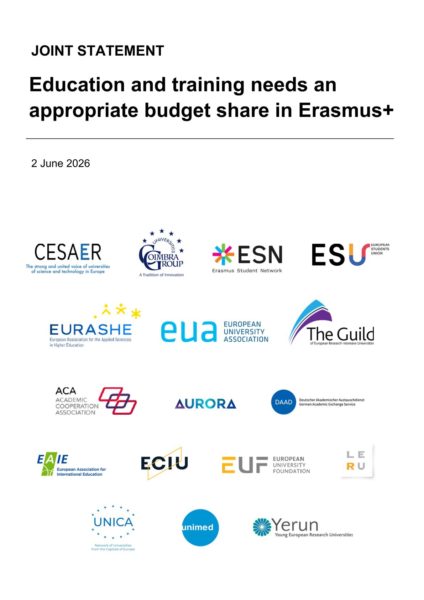
Joint Statement: Education and training needs an appropriate budget share in Erasmus+
02 June 2026
17 organisations – including UNICA – have launched a new joint statement that urges the European Parliament to readjust the proposed budget share for education and training to its level under the current programme, recognising its importance at the core of Erasmus+, the European Education Area and the Union of Skills, as well as the EU’s competitiveness agenda.
Erasmus+ changes lives, strengthens education and builds the next generation of Europeans.
The next programme must be equipped with the budget, governance, funding lines and predictability needed to continue delivering for learners, staff, institutions and society, while reinforcing international collaboration and systematically enhancing its accessibility to all.
Signatories
- Academic Cooperation Association (ACA) – https://aca-secretariat.be/
- AURORA – https://aurora-universities.eu/
- CESAER – https://www.cesaer.org/
- Coimbra Group – https://www.coimbra-group.eu/
- German Academic Exchange Service (DAAD) – https://www.daad.de/en/
- European Association for International Education (EAIE) – www.eaie.org
- European Consortium of Innovative Universities (ECIU) – https://www.eciu.eu/
- Erasmus Students Network (ESN) – https://www.esn.org/
- European Students’ Union (ESU) – https://esu-online.org/
- European University Association (EUA) – https://www.eua.eu/
- European University Foundation (EUF) – https://uni-foundation.eu/
- European Association for the Applied Sciences in Higher Education (EURASHE) – https://www.eurashe.eu/
- The Guild – https://www.the-guild.eu/
- League of European Research Universities (LERU) – https://www.leru.org/
- Network of Universities from the Capitals of Europe (UNICA) – www.unica-network.eu
- Mediterranean Universities Union (UNIMED) – https://www.uni-med.net/
- Young European Research Universities Network (YERUN) – https://yerun.eu/
 Co-funded by the European Union. Views and opinions expressed are however those of the authors only and do not necessarily reflect those of the European Union or the European Education and Culture Executive Agency (EACEA). Neither the European Union nor the granting authority can be held responsible for them.