
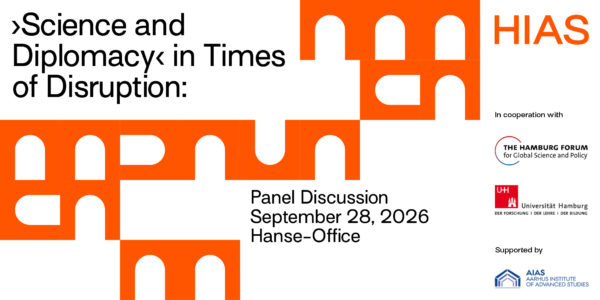
Panel Discussion supported by GICHE: “‘Science and Diplomacy’ in Times of Disruption: How Must International Research Institutions Adapt to Continue Successful Global Science Cooperation?” | 28 Sep, Brussels
31 July 2026 | From partners
The Global Innovation Circle on Higher Education (GICHE), a new international platform bringing together leaders of major university networks worldwide launched in 2025, is supporting a public Panel Discussion on 28 September, at the Hanse-Office – Joint representation of the city of Hamburg and the federal state of Schleswig-Holstein in Brussels.
The theme of the panel discussion, “‘Science and Diplomacy’ in Times of Disruption: How Must International Research Institutions Adapt to Continue Successful Global Science Cooperation?“, aims to foster a conversation on the strategic and coordinated actions that academic institutions need to carry out in order to prepare for a future in which science and academia play a key role in global cooperation.
Interested academics, academic managers, and policy stakeholders, and other relevant stakeholders are welcome to join this event. Registrations are open here, until 31 August. The discussion will be available as a live stream. Access details will be provided prior to the event. Please indicate this preference when registering.
Luciano Saso, Secretary-General of UNICA, will be attending this meeting on behalf of UNICA.
The event is co-organized by the Hamburg Institute for Advanced Study and University of Hamburg within the framework of the “Hamburg Forum for Global Science and Policy”, in cooperation with the Free and Hanseatic City of Hamburg and the Aarhus Institute of Advanced Studies.
About the theme
As geopolitical tensions reshape international cooperation, science is taking on an increasingly important diplomatic role. Research institutions, universities and scientific networks are not only advancing knowledge but also helping to sustain international dialogue, build partnerships, and safeguard academic freedom.
How can internationally oriented research institutions respond to these changing conditions? What opportunities and risks does Science Diplomacy present? And what strategic action is needed at institutional, European, and global levels?
Representatives from academia, research organisations, scientific networks and policymakers from Hamburg, Europe and the African continent will be discussing the future of international science cooperation in an increasingly fragmented world.
 Co-funded by the European Union. Views and opinions expressed are however those of the authors only and do not necessarily reflect those of the European Union or the European Education and Culture Executive Agency (EACEA). Neither the European Union nor the granting authority can be held responsible for them.