

From Knowledge to Impact: our shared journey for 2026/27
01 October 2026 | From UNICA
UNICA is pleased to welcome a new academic year by sharing the theme that will guide our work in the next months: From knowledge to impact. Universities driving democratic and sustainable futures.
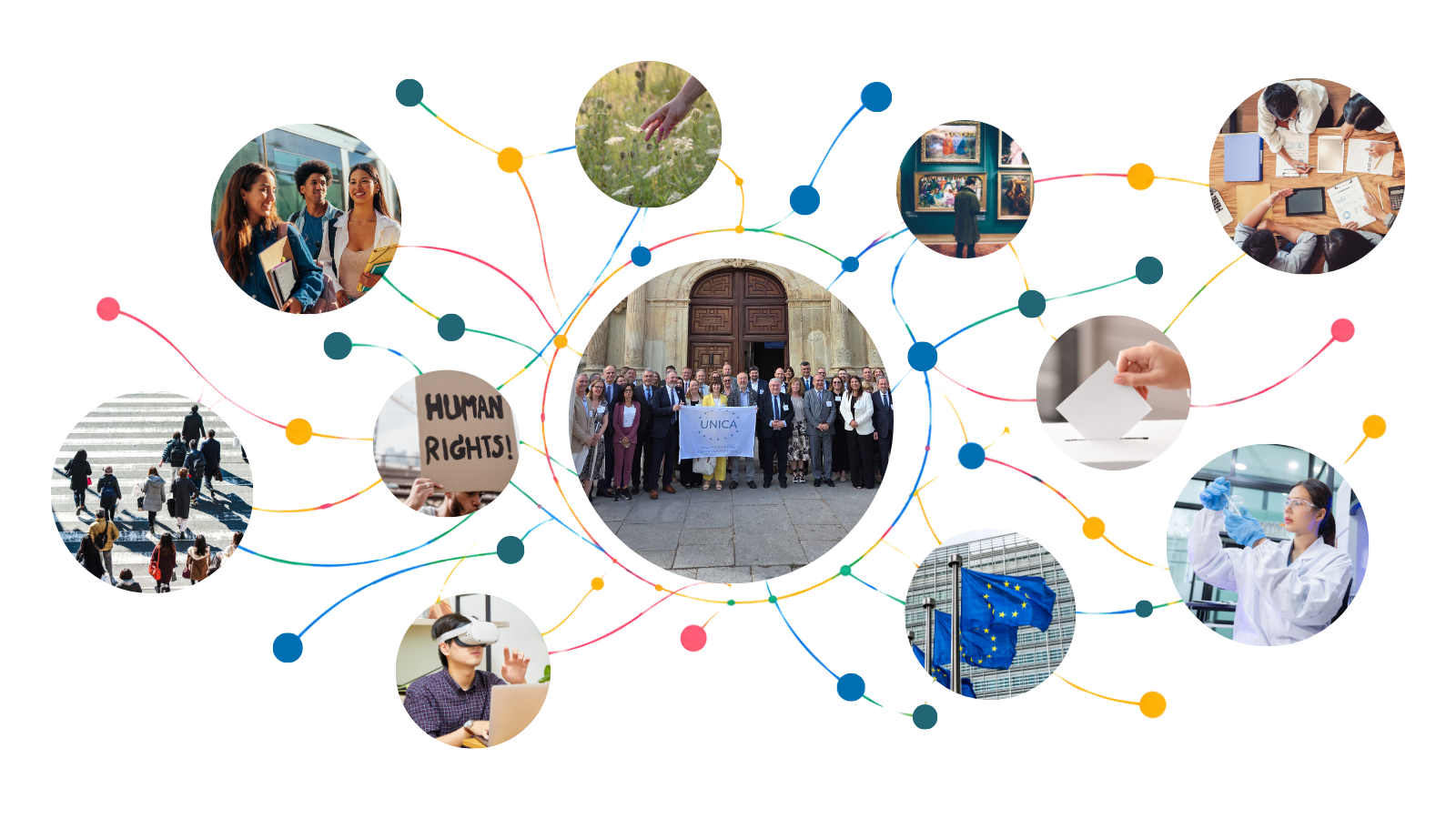
Universities produce knowledge, educate people, develop technologies and create spaces for exchange. But the challenges facing our societies do not stop at the university gates. Climate change, technological transformation, growing inequalities and pressure on democratic life require more than knowledge about the problems. They require people and institutions able to use what they know and turn ideas into action.
This does not suggest that universities have been preparing while others have been acting. Universities are already deeply engaged with their societies through research, education, partnerships and innovation. The objective is to bridge the gap between what universities know and what societies need – and how to put their knowledge and capacities to work in the present.
This matters particularly for democracy. A democratic future is not simply one in which democratic institutions survive pressure. Democracy is also something we practice: through dialogue, participation, critical thinking, disagreement and the ability to encounter people and ideas different from our own. Universities have a particular role in creating spaces where these practices can take place.
Throughout the year, UNICA will bring members together to exchange practices, learn from one another and explore how universities can connect knowledge with societal needs and turn collective capacity into action.
From knowledge to impact is therefore more than a theme for our programme. It is an invitation to ask what universities do with what they know – and what becomes possible when that knowledge is put into practice.
How are we doing it?
We continue our work of providing a forum for our members to reflect on the latest developments and trends impacting European higher education and research:
- We’re supporting our members in developing build expertise and capability
As always, we continue providing opportunities for our members to learn, develop expertise and build the capacity they need to respond effectively to emerging challenges. - We’re connecting people, institutions and cities
We create spaces for universities, academics, students, cities and partners to exchange ideas, build relationships and learn from one another. - We’re bringring our members’ perspectives to decision-makers
We bring the collective knowledge and experience of our members into conversations that turn ambitions on education, skills, research, democracy and sustainability into tangible change. - We’re fueling imagination and creativity
We highlight new ideas, innovative approaches and inspiring examples from across our network, showcasing the possibilities the future holds.
Our priorities
UNICA’s activities span all areas of university life, but in 2026/27 we will place particular emphasis on three interconnected challenges: democracy, sustainable development and technological transformation. These priorities give concrete direction to our overarching theme, “From knowledge to impact. Universities driving democratic and sustainable futures.”
Our focus is not simply on discussing these challenges. It is on creating opportunities for members to exchange knowledge and practices, strengthen institutional capacity, develop partnerships and bring the experience of universities into wider conversations. Across the programme, we will continue to connect research, education and innovation with societal needs, building on the particular position of UNICA universities as institutions rooted in their cities while connected to European and global networks.
Democracy
Strengthening the capacity of universities to protect democratic values and contribute to democratic societies.
In 2026/27, UNICA will continue to work on the conditions that allow universities to fulfil their civic role: academic freedom, institutional autonomy, critical thinking, dialogue and engagement with society. Building on the 2026 work on academic freedom and on discussions around the civic role of universities, we will create further opportunities for members to exchange institutional practices and explore how universities can contribute to democratic resilience.
This work will continue through UNICA’s Leadership and Governance activities, Rectors’ Seminars and policy engagement, as well as through activities connecting universities with cities, students, civil society and other stakeholders. The 2027 UNICA CAPITALs Series, “Can Universities Help to Address the Crisis in Democracy?”, and the conference “Democracy at the Crossroads: European Universities and the Politics of the Future” will take these questions further, examining how universities can create spaces for participation, critical inquiry and democratic practice.
Our focus:
How can universities put their knowledge, people and institutional capacity to work in strengthening democratic life?
Sustainable development
Connecting university knowledge, research and innovation with the sustainability challenges facing societies.
The 2026-2027 programme will strengthen UNICA’s work on sustainability and the Sustainable Development Goals, with a particular focus on how universities can move from identifying global challenges to developing and testing responses. This means connecting research and innovation with education, cities, communities and policy, and creating opportunities for members to share approaches that can be adapted across different institutional and urban contexts.
The UNICA Research Meeting “Advancing Research for a Sustainable Future” will bring together these different dimensions through discussions on climate and environmental sustainability, sustainable cities, green technologies, COP31, digital transformation and responsible innovation. The 2027 UNICA Days, “Universities for a Sustainable Future – Beyond the 2030 Agenda,” will then look beyond the current SDG framework and ask what role universities can play in shaping the next phase of global sustainable development.
Our focus:
How can universities put their knowledge, research and partnerships to work in addressing the sustainability challenges of the present and shaping more sustainable futures?
Technological transformation
Building the capacity of universities to respond to AI and digital transformation while keeping their educational and societal missions at the centre.
Artificial intelligence is changing how universities teach, conduct research, produce knowledge and organise their institutions. UNICA will use its network to move beyond questions of technology adoption and explore what this transformation means for university governance, academic practice, research, skills and the relationship between universities and society.
The “Building the AI-Ready University” conference, the UNICA Research Meeting, and the UNICA IRO Meeting on the next Erasmus+ era will provide spaces for members to examine different dimensions of this transformation. This work will also connect with UNICA’s focus on innovative, digital and inclusive learning, research and innovation capacity, and international cooperation. The 2026 Rectors’ Seminar already highlighted AI as a systemic issue requiring attention to infrastructure, pedagogy, ethics and institutional capacity – rather than simply the introduction of new tools.
The aim is not to predict what the university of the future will look like, but to help our members build the capacity to shape it: using new technologies to expand knowledge and opportunity while safeguarding critical thinking, academic values, inclusion and human judgement.
Our focus:
How can universities put AI and emerging technologies to work in ways that strengthen knowledge, education and society?
From priorities to impact
These three priorities are not separate strands of work. They intersect throughout the programme. AI raises questions about democracy, inequality and institutional autonomy; sustainability depends on research, innovation and cooperation; and democratic resilience depends on universities’ ability to educate, produce knowledge and engage with their communities.
Across all three, the ambition is the same: to help universities move from knowledge to impact – not by doing more for the sake of it, but by creating the conditions, partnerships and institutional capacity needed to put what universities know to work.
 Co-funded by the European Union. Views and opinions expressed are however those of the authors only and do not necessarily reflect those of the European Union or the European Education and Culture Executive Agency (EACEA). Neither the European Union nor the granting authority can be held responsible for them.