

Conversations for the future of Higher Education & Research | Roundup October 2026
28 October 2026 | From UNICA

Autumn has arrived, and clocks have gone back one hour in most European countries. But while the days grow shorter and temperatures drop, discussions concerning the future of higher education and research are far from cooling down. Here’s a look back at the key meetings, the issues that took centre stage, and the discussions that UNICA particpated in.
1 | Building active values-based universities
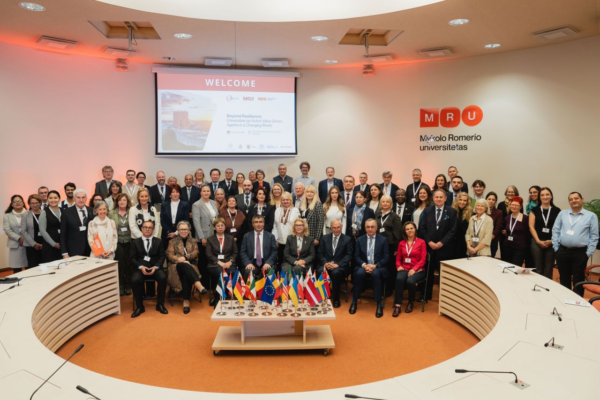
📍Mykolas Romeris University, Vilnius
In mid-October, UNICA Secretary General Luciano Saso travelled to Vilnius for a commemorative event celebrating the anniversary of the Magna Charta Universitatum, the declaration that sets out the fundamental values underpinning universities worldwide.
Luciano moderated the session “Beyond cooperation: European networks and University Alliances and the future of academic values. How European University Alliances can reinforce the Magna Charta values?”. He highlighted the particular role of European University Alliances in advancing these principles, describing them as “laboratories for value-based innovation” and “a kind of stress test for academic values”.
Moving beyond the structures of the Alliances themselves, the discussion also explored the broader vision they can help shape for European higher education. Ahead of the event, University World News spoke with Luciano Saso and Romiță Iucu, President of the Board of Trustees at the University of Bucharest, Romania, Secretary General of CIVIS – Europe’s Civic University Alliance, and coordinator of UNICA’s Education Cluster. Both highlighted the importance of the Magna Charta Observatory (MCO) in broadening the conversation: not only considering what European University Alliances can do for universities, but also how they can contribute to a new future for European cooperation and prosperity.
Read the article on University World News.
Learn more about the Anniversary event of the MCU or review the sessions & presentations, here.
2 | Safeguarding academic values in the era of Artificial Intelligence
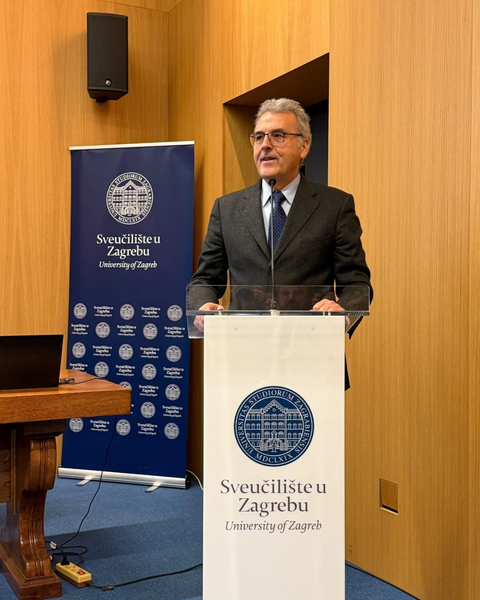
📍University of Zagreb
Artificial Intelligence is likely the most debated topic in universities lately – and rightfully so. Just a few days after the UNICA Conference “Building the AI-Ready University”, hosted by Queen’s University Belfast, Secretary General Luciano Saso travelled to Zagreb, where he delivered the opening talk on the 2nd Digital Transformation Day, dedicated to “Responsible Use of Artificial Intelligence”.
The conference revisited several themes raised at the previous meeting in Belfast, particularly the need to safeguard academic values and maintain the quality of teaching, learning and research amid ongoing changes in higher education.
In a rapid changing environment powered by technological development, universities face growing pressure to rethink established approaches and revisit traditional roadmaps. The challenge lies in keeping pace with innovation while ensuring that its integration strengthens, rather than undermines, the quality, values and mission of higher education.
3 | Keeping Erasmus+ high on the agenda
📍Brussels
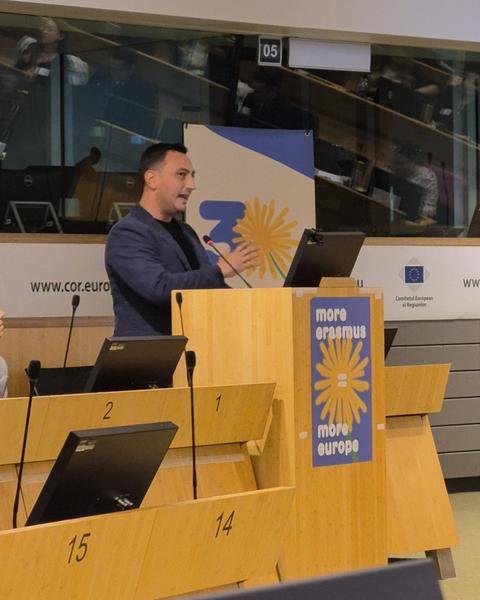
Meanwhile, in Brussels, one of the most pressing issues for the higher education sector remains the future of Erasmus+. At the beginning of the month, UNICA Project & Policy Officer Federica Nestola took part in another meeting of the Erasmus+ Coalition, where members reaffirmed their shared priorities: advocating for a budget of at least €47.4 billion, keeping Erasmus+ high on the political agenda throughout the negotiations on the next Multiannual Financial Framework (MFF), and contributing concrete recommendations to the design and implementation of the next programme.
Later on, on 16 October, UNICA also attended the Conference “The Future of Erasmus+ Starts with Youth”, organised by the European Youth Forum. The timely event put young people’s experiences at the centre of the discussion, highlighting real-life stories that demonstrate the transformative impact of Erasmus+. By bringing these experiences to the attention of policymakers, the conference aimed to underline the programme’s added value and reinforce the case for sustained, ambitious investment in its successor programme.
A positive development followed on 22 October, when the European Parliament adopted its position on Erasmus+ for 2028–2034, calling for a budget of €47.39 billion and a programme better equipped to respond to Europe’s challenges.
However, the final budget remains under negotiation, and the programme’s future will depend not only on the resources allocated to it, but also on the rules governing how those resources are translated into opportunities. The coming months will therefore be crucial in shaping both the scale of Erasmus+ and the framework through which it will support students, universities and the wider European education community.
Read Federica Nestola’s article about the next steps for Erasmus+ on LinkedIn.
4 | Bringing Europe closer to students
📍European Parliament, Brussels
The UNICA Office Coordinator, Laura Brossico, and Project & Policy Officer, Federica Nestola, also had the opportunity to meet with the Youth Outreach Unit from the European Parliament this month, following up on a partnership that started in 2024, on the occasion of the first edition of the UNICA Days.
Founded on the ambition of bringing students closer to European institutions, the partnership has enabled students from UNICA member universities to take part in the European Youth Event (EYE 2025), in Strasbourg, last year. Their ideas, perspectives and visions for the future of Europe are captured in the publication “Young, Loud, Leading: Reflections from UNICA Students at the European Youth Event (EYE 2025)”.
News on upcoming initiatives in the context of the partnership are coming soon!
 Co-funded by the European Union. Views and opinions expressed are however those of the authors only and do not necessarily reflect those of the European Union or the European Education and Culture Executive Agency (EACEA). Neither the European Union nor the granting authority can be held responsible for them.