

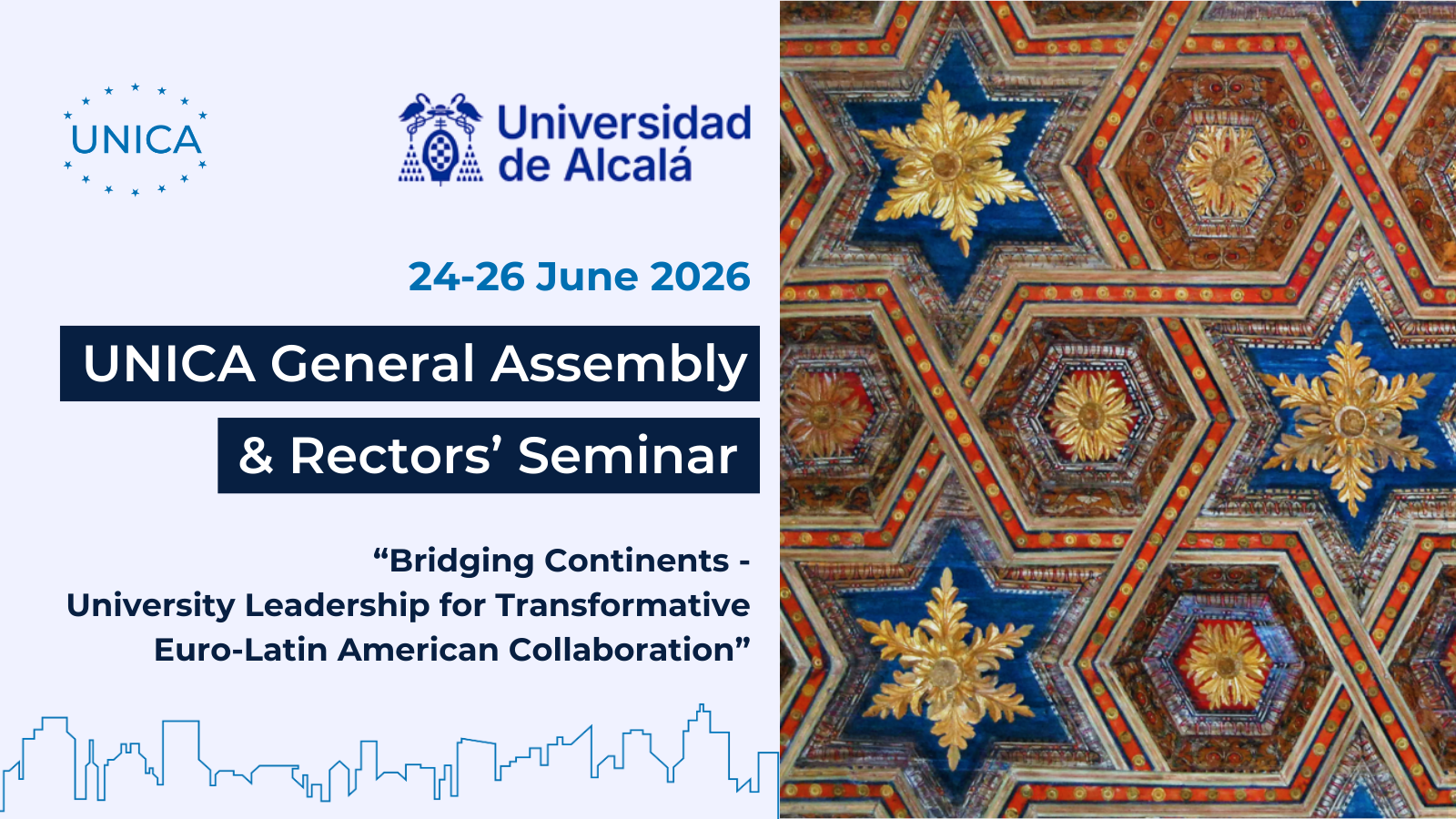
36th UNICA General Assembly and Rectors’ Seminar on Euro-Latin American Collaboration | 24-26 June 2026, University of Alcalá
About the event
From 24 to 26 June 2026, the highest body of the network was hosted by the University of Alcalá for its annual meeting and the Rectors’ Seminar “Bridging Continents – University Leadership for Transformative Euro-Latin American Collaboration”.
The event gathered more than 65 participants from both Europe and Latin America, and 34 UNICA member universities were represented in the General Assembly and the conference.
More about the theme of the Seminar
Universities are increasingly called to act as bridges between regions, cultures, and societies. In today’s interconnected yet fragmented world – marked by geopolitical tensions, environmental crises, technological disruption, and widening social inequalities – cooperation beyond geographical and political boundaries has become an imperative for higher education. Institutions are expected not only to generate knowledge, but also to contribute to societal resilience, democratic stability, and inclusive development.
Latin America and Europe share a long history of cultural exchange, intellectual dialogue, and political cooperation. This legacy has been reaffirmed in recent years through renewed high‑level political engagement, including the EU‑CELAC Summit held in Brussels in July 2023, which relaunched the bi‑regional partnership and emphasised cooperation on multilateralism, climate action, digital transformation, and social cohesion. The partnership was further strengthened at the 4th EU‑CELAC Summit in Santa Marta (Colombia) in November 2025, where Heads of State and Government adopted a comprehensive Joint Declaration outlining shared commitments on renewable energy, inclusive digitalisation, climate adaptation, biotechnology, food security, migration, and the defence of democracy, human rights, and the rule of law.
These summits underscore the strategic importance of the bi‑regional relationship and highlight areas where universities can play a decisive role: advancing research and innovation, supporting evidence‑based policymaking, fostering people‑to‑people contacts, and contributing to sustainable development. Latin America, with its vibrant academic traditions, demographic dynamism, and expanding research ecosystems, is an indispensable partner for Europe. Conversely, European universities offer opportunities for joint knowledge production, mobility, and capacity building, while contributing to the development of inclusive and equitable cooperation frameworks. Yet collaboration between the two regions continues to face structural obstacles: asymmetries in resources and research capacity, fragmented policy environments, language barriers, and uneven access to mobility and funding instruments.
Against this backdrop, the UNICA Rectors’ Seminar 2026 explored the opportunities and challenges of strengthening cooperation with Latin America through four interconnected themes. The discussions examined how universities can foster long‑term, structurally embedded partnerships; how they can act as agents of civic change through research and knowledge transfer; how they can develop innovative pedagogies in the AI era that promote inclusion and academic integrity; and how they can contribute to joint responses to global challenges, including the reinforcement of democracy, human rights, and the rule of law – priorities explicitly reaffirmed in the 2025 EU‑CELAC Joint Declaration. The Seminar explored how universities can further continue to serve as strategic connectors between Europe and Latin America, fostering dialogue, supporting informed policy engagement, and advancing forms of academic cooperation that remain both impactful and sustainable.
More about the host institution, the University of Alcalá
The University of Alcalá is a public university committed to excellence in teaching and research by adapting its curriculum to the changes and demands of society and attracting and retaining talent.
Located in the historic city of Alcalá de Henares, 30 kilometers from Madrid, it has 28,000 students, 2,000 teachers, and 800 administrative and service staff positions. It is one of the oldest universities in Europe, dating back to the General Studies program of 1293. In 1499, Cardinal Cisneros founded the College of San Ildefonso with the aim of creating a model for a university city that would serve as a template for others in Latin America. The uniqueness of its university model and the preservation of its rich architectural and artistic heritage led to its declaration as a World Heritage Site by UNESCO in 1998.
Learn more on the university’s website.
Documents

24-26 June 2026
Alcalá de Henares, Madrid
University of Alcalá
 Co-funded by the European Union. Views and opinions expressed are however those of the authors only and do not necessarily reflect those of the European Union or the European Education and Culture Executive Agency (EACEA). Neither the European Union nor the granting authority can be held responsible for them.