
Education and training needs an appropriate budget share in Erasmus+ | Joint Statement by 17 organisations
02 June 2026 | From UNICA - Funding
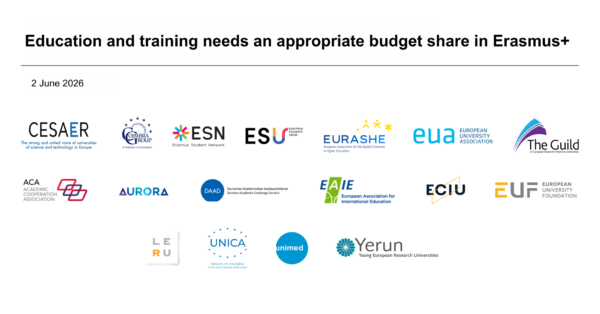
In a new effort to secure an adequately funded Erasmus+, 17 organisations – including UNICA – have launched a new joint statement that urges the European Parliament to readjust the share of funding allocated to education and training in the next Erasmus+ programme (2028-2034), following a proposed reduction in the CULT Committee’s draft report.
The organisations acknowledge and welcome the substantial positive developments presented in the draft report, welcoming welcome MEP Bogdan Zdrojewski’s central message: “Erasmus+ must remain, first and foremost, Europe’s flagship programme for education and training, learning mobility and transnational cooperation, with a budget that fully reflects the level of ambition, expectations and objectives that this entails.“
Nevertheless, the signatories express their concerns that the budget still falls short to fulfil the level of ambition, expectations and objectives of the programme, arguing that “… the budget would still only just allow the programme to maintain its current level of activities.“
If Erasmus+ is to become a comprehensive instrument supporting cooperation, capacity-building and learning opportunities across all education sectors and beyond, then it must be equipped with adequate funding, strong governance and long-term predictability.
Read the full statement and join us in calling for a well-funded Erasmus+ by sharing this joint statement!
List of signatories:
- Academic Cooperation Association (ACA) – https://aca-secretariat.be/
- AURORA – https://aurora-universities.eu/
- CESAER – https://www.cesaer.org/
- Coimbra Group – https://www.coimbra-group.eu/
- German Academic Exchange Service (DAAD) – https://www.daad.de/en/
- European Association for International Education (EAIE) – www.eaie.org
- European Consortium of Innovative Universities (ECIU) – https://www.eciu.eu/
- Erasmus Students Network (ESN) – https://www.esn.org/
- European Students’ Union (ESU) – https://esu-online.org/
- European University Association (EUA) – https://www.eua.eu/
- European University Foundation (EUF) – https://uni-foundation.eu/
- European Association for the Applied Sciences in Higher Education (EURASHE) – https://www.eurashe.eu/
- The Guild – https://www.the-guild.eu/
- League of European Research Universities (LERU) – https://www.leru.org/
- Network of Universities from the Capitals of Europe (UNICA) – www.unica-network.eu
- Mediterranean Universities Union (UNIMED) – https://www.uni-med.net/
- Young European Research Universities Network (YERUN) – https://yerun.eu/
Related publications:
- Joint Amendments to the Erasmus+ Proposal (Feb 2026)
- A stronger Europe needs a properly funded Erasmus+ (Jan 2026)
Dig deeper: what are the Erasmus+ programme’s ‘growing expectations’?
Erasmus+ today is expected to do far more than the traditional student exchange programme it started as. This is why, despite an increased budget, a lower share of funding allocated to education and training won’t be enough to achieve the objectives the European Commission aims for Erasmus+ over the period 2028-2034. Here are the structural changes in the programme’s regulation that justify the sector’s push for a readjustment of the budget share:
1- Broader scope: Erasmus+ no longer focuses mainly on university student mobility, supporting a wider range of sectors, participants and activities, including schools, vocational education, adult learning, youth, sport and international cooperation;
2- Expanded actions: The programme is increasingly expected to address EU priorities such as inclusion, digital transformation, sustainability, democratic participation and the development of future-oriented skills;
3- Greater impact: It is expected that the programme delivers greater impact on education, skills, employability, social cohesion and European competitiveness and citizenship, contributing to broader EU policy goals.
If you wish to learn more about the current Erasmus+ updates, read UNICA’s April Newsletter, ” A New Trajectory for Erasmus+”, dedicated to the undergoing programme negotiations.
 Co-funded by the European Union. Views and opinions expressed are however those of the authors only and do not necessarily reflect those of the European Union or the European Education and Culture Executive Agency (EACEA). Neither the European Union nor the granting authority can be held responsible for them.