
Earth Day 2026: what are universities doing for our planet?
22 April 2026 | From UNICA - From our Members
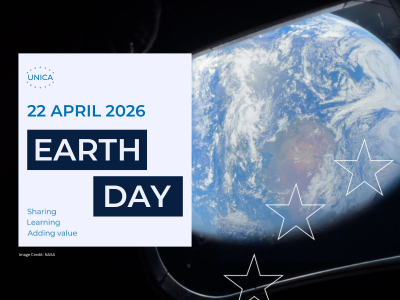
April 22 is Earth Day! First marked in 1970, Earth Day emerged from a growing awareness of environmental challenges and has since become a global movement, mobilising individuals, institutions, and policymakers to take action on issues such as climate change, biodiversity loss, and pollution. Today, Earth Day remains a moment to both raise awareness and highlight solutions. Universities, as centres of research and innovation, play a key role in this effort.
This year, more than highlighting the potential universities hold to tackle Earth related challenges, we highlight a few examples on how UNICA member universities are already advancing knowledge and innovation to better understand and protect the planet.
Take a look at how universities are advancing research on a few fundamental elements that shape our planet:
🌊 WATER | University of Iceland
At the University of Iceland, researchers are exploring the complex dynamics of marine ecosystems, with a particular focus on whales and ocean life. For instance, research based in Húsavík shows that whales are not just species to observe, but essential drivers of ocean systems. Through their movements, feeding behaviour, and biological activity, they influence nutrient cycles, marine ecosystems, and even the global carbon cycle. This work helps deepen our understanding of how climate change affects the oceans and supports more sustainable approaches to marine conservation. Learn more
🌱 EARTH | University of Ljubljana
Researchers from the University of Ljubljana are contributing to the BIOMASS satellite mission, which is designed to measure how much carbon is stored in the world’s forests. By providing more accurate global data on forest biomass, the mission plays a crucial role in understanding the carbon cycle and informing climate action. Learn more
🌬️ AIR| Université libre de Bruxelles (ULB)
In Brussels, researchers at ULB are working on air quality, pollution exposure, and their impact on public health. By developing data-driven tools and insights for policymakers, their work contributes directly to shaping environmental and health policies at both city and European levels.
Despite already a few years, it’s worth highlighting this citizen science project CurieuzenAir, which engaged 3,000 Brussels residents in measuring nitrogen dioxide (NO₂) levels across the city, creating a unique dataset that revealed stark inequalities in air quality between neighbourhoods while also showing encouraging improvements in recent years. Learn more
🔥 ENERGY | University of Copenhagen
At the University of Copenhagen, research into renewable energy systems and decarbonisation is helping to accelerate the transition away from fossil fuels. Research into Power-to-X technologies shows how renewable electricity from wind and solar can be converted into hydrogen and other carbon-neutral fuels, providing a way to store energy and replace fossil fuels in sectors like aviation, shipping, and heavy industry that cannot be easily electrified. Learn more
🦫 BIODIVERSITY | University of Zagreb
As part of the consortium behind the LIFE BEAVER project, the University of Zagreb is working to reduce human–beaver conflicts while promoting sustainable ecosystem management. By recognising the beaver as a keystone species, the project highlights its role in maintaining biodiversity, improving water systems, and contributing to climate change mitigation. Learn more
🌌 SPACE | Tor Vergata University of Rome + ULB
Researchers from Tor Vergata and ULB are part of an international consortium that is exploring fundamental questions about the nature of space and time. Together with 15 other research institutions from across the globe, the project objectives sit at the intersection of quantum information, spacetime, and gravity, with the long-term goal of reshaping our understanding of spacetime as an emergent or operational concept. Learn more
 Co-funded by the European Union. Views and opinions expressed are however those of the authors only and do not necessarily reflect those of the European Union or the European Education and Culture Executive Agency (EACEA). Neither the European Union nor the granting authority can be held responsible for them.