
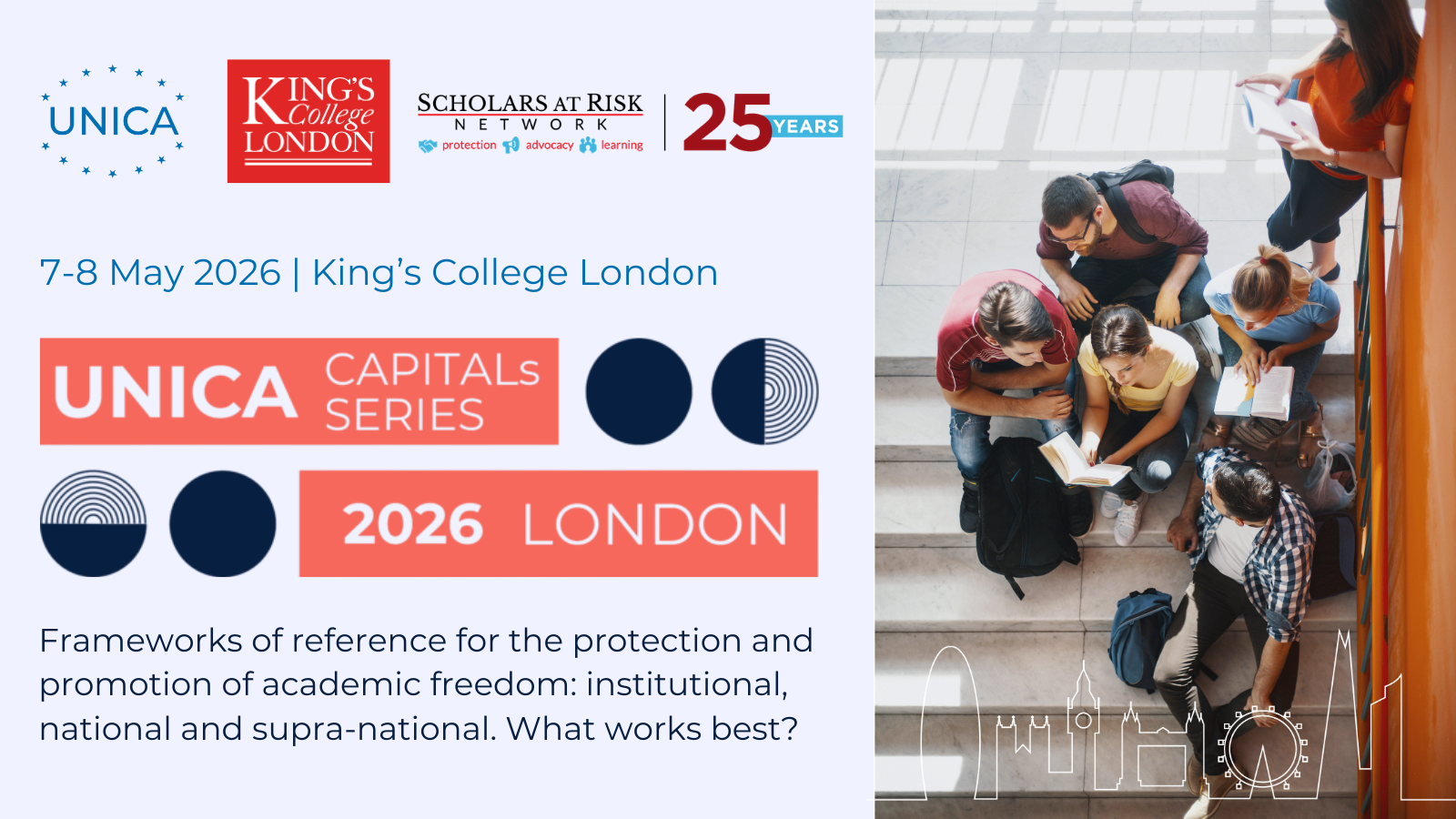
Frameworks of reference for the protection and promotion of academic freedom: institutional, national and supra-national. What works best?
King’s College London
Higher Education CAPITALs is an annual event held at the end of May, in London. It brings together higher education leaders, researchers, public authorities and media representatives from Europe and beyond, to identify and discuss difficult, important and often neglected contemporary issues that are of key relevance for universities and the communities they serve.
It is organized jointly by UNICA and the School of Education, Communication and Society of King’s College London, through GOAF – the Global Observatory on Academic Freedom.
Higher Education CAPITALs 2026
At present, threats to academic freedom come from many directions, mainly from outside higher education institutions but, also, sometimes from within. In the last decade, we have witnessed a series of attempts to (re)codify and regulate academic freedom as part of efforts to protect and promote it under new and evolving circumstances, or, quite the contrary, to restrict or even repress it. The concept of frameworks of reference for academic freedom has proven a useful tool in analysing and explaining this development and also in suggesting new, and supporting continuing, ways of action in defense of academic freedom. This conference will bring together university leaders, researchers, and other key higher education stakeholders to take the pulse with regard to the emergence of new frameworks of reference. In particular, it will discuss about the responsibility and also the latitude of the universities themselves in developing institutional frameworks of reference, and in engaging with external stakeholders and authorities in developing national or supra-national frameworks of reference.
Scholars at Risk’s 25th anniversary framework
This year, the event is also taking place in the framework of the 25th anniversary of Scholars the Scholars At Risk, of which UNICA is a member of. The year-long celebration (2025-2026) of shared accomplishments is dedicated to theme “Truth Matters,” and serves an opportunity to recommit to the work and the values of advocating for stronger protections for academic freedom worldwide.
To explore the theme, currently over 100 member institutions from 27 countries have pledged to carry out an activity or event over SAR’s anniversary year. You can view a full list of pledged institutions and completed activities here.
The UNICA-SAR Partner Network was formed in 2011 to foster stronger collaboration among higher-education institutions in Europe and around the world in support of academic freedom and the protection of at-risk academics.
Target groups
Vice-Rectors for education and/or student affairs, representatives of academic leadership, responsible of education & teaching, Deans, Directors for innovation in education and coordinators of study programmes from UNICA members.
Please note that registration will remain open until 27 April 2026, unless capacity is reached before that date.
Register here!
 Co-funded by the European Union. Views and opinions expressed are however those of the authors only and do not necessarily reflect those of the European Union or the European Education and Culture Executive Agency (EACEA). Neither the European Union nor the granting authority can be held responsible for them.