

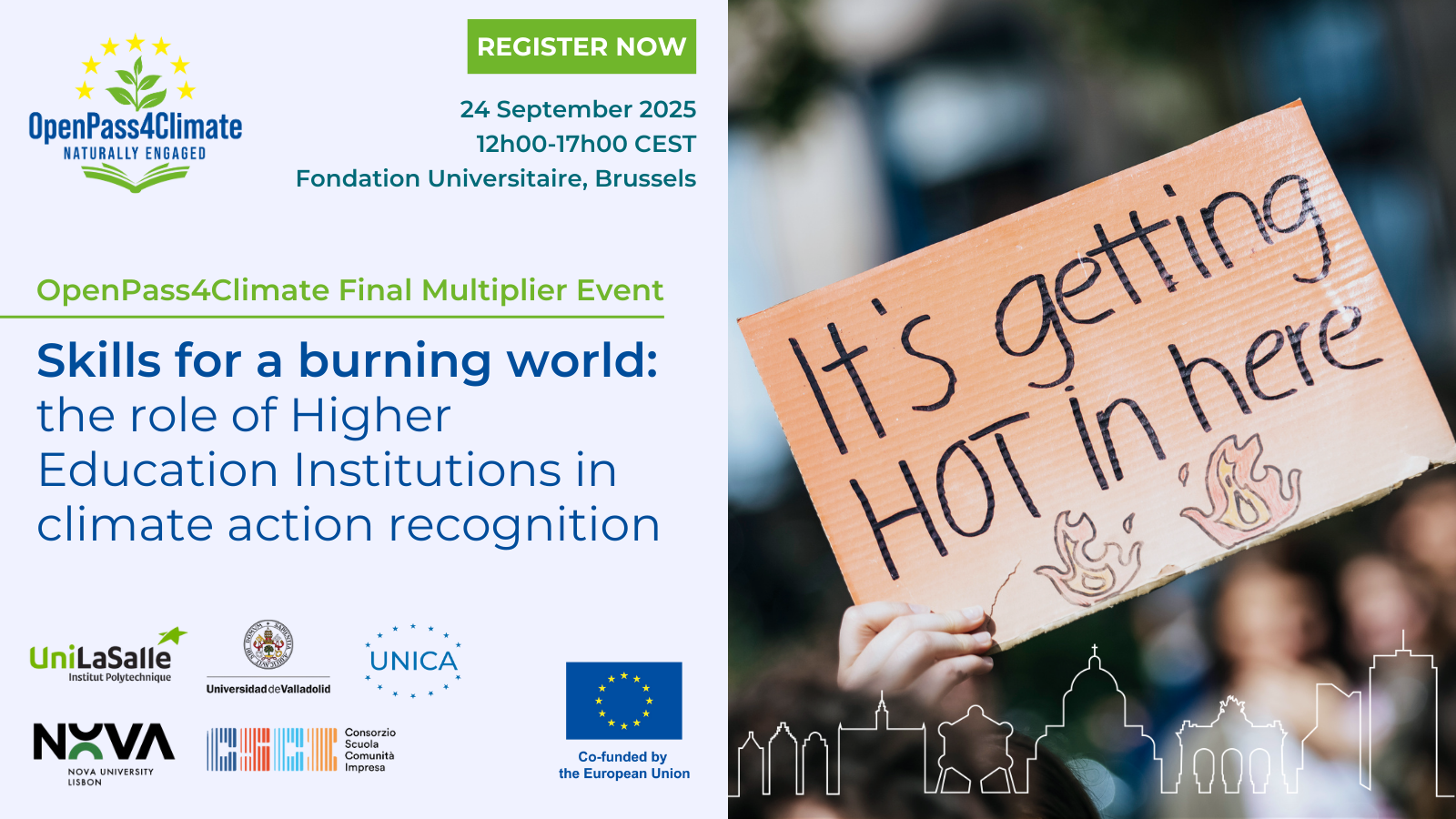
Skills for a burning world: the role of HEIs in climate action recognition | 24 Sep 2025, Brussels
The OpenPass4Climate consortium organised the final multiplier event of its Erasmus+ KA2 projectat the Fondation Universitaire in Brussels on the afternoon of 24 September 2025.
The event presented a set of recommendations for higher education institutions to adopt its Open Badges and Passport system and offer a space for exchange between Higher Education Institutions (HEIs), EU policymakers, student organisations, and civil society stakeholders on the role of universities in the recognition of climate competences. The focus was on how microcredentials, open badges, and digital recognition systems can support climate action, civic engagement, and the development of relevant green skills.
Key discussion points:
- The strategic role of Higher Education Institutions in recognising climate competences developed beyond the traditional classroom.
- The potential of microcredentials and open badges to empower students, enhance employability, and engage employers.
- Aligning recognition practices with EU frameworks such as GreenComp, DigComp, and the European approach to microcredentials.
- Overcoming institutional barriers and designing inclusive, credible, and scalable recognition ecosystems.

Report
On 24 September, UNICA brought together several representatives from universities, student organisations and educators in Brussels for the project’s final multiplier event, “Skills for a Burning World: The Role of HEIs in Climate Action Recognition.” The event focused on how higher education can better support climate action and sustainability learning through innovative recognition systems.
The event opened with welcoming remarks and a presentation of the OpenPass4Climate (OP4C) project, an Erasmus+ KA2 initiative led by UniLaSalle and partnered by UNICA. The project has developed an Open Badges and Passport system to formally recognise sustainability competences and civic engagement in all education levels, bridging the gap between formal learning and real-world climate action.
The central panel, “Skills for a Burning World,” moderated by Federica Nestola (Project and Policy Officer at UNICA), invited speakers Fatma Fourati-Jamoussi (Lecturer-researcher in Marketing and Strategic Intelligence at UniLaSalle) and Simone Lepore (President of Erasmus Student Network), to reflect on how universities can better acknowledge student contributions to the green transition.
Opening the discussion, Federica Nestola set the stage by highlighting that climate change is not a distant challenge but a present emergency already reshaping Europe’s ecosystems and societies. She noted that while youth awareness and activism remain strong – supported by data from the EU Youth Report 2024 and recent Eurobarometer findings – education systems have yet to fully respond to this urgency. Traditional curricula often fail to equip students with the interdisciplinary, civic, and practical competences needed to navigate complex sustainability challenges.
Federica underlined the critical role of education as an enabler of climate action, recalling how the European Green Deal and the European Skills Agenda both position learning and upskilling as central to achieving a just and sustainable transition. However, she stressed that much of the most impactful climate learning happens outside formal classrooms – through student projects, civic engagement, and community initiatives – which remain largely invisible within institutional frameworks.
Fatma Fourati-Jamoussi highlighted how OpenPass4Climate represents a pioneering step towards a culture of recognition within European universities. She emphasised that the project’s digital Open Badges and Passport system offer a credible and transferable way to document sustainability competences developed both inside and outside the classroom, and concluded by noting that we need to teach and assess sustainability as whole institutions, guided by shared frameworks that bring together teaching, research, and community engagement. Only by embracing sustainability at 360 degrees can universities truly prepare students to lead the transition toward a just and climate-resilient future.
Simone Lepore offered the student perspective, stressing the importance of inclusive and accessible recognition mechanisms that value civic engagement, volunteering, and activism as integral parts of learning. He noted that students are increasingly aware of the relevance of climate and sustainability competences for their employability, yet universities often lack the tools to formally validate these experiences. He called for stronger collaboration between HEIs and student organisations to co-design recognition systems that reflect the diversity of student learning paths.
The afternoon continued with the presentation of one of the project’s results: a set of policy recommendations for Higher Education institutions, titled “Credentialing Climate Competence in Higher Education: Recognizing Sustainability Learning for a Greener, More Inclusive University System.” The recommendations outline strategic actions for universities, to integrate sustainability competences into curricula and recognition frameworks at institutional, national, and European levels.
The final part of the event featured an open discussion and co-creation session moderated by Inês Cisneiros (Project and Policy Officer at UNICA), where participants exchanged ideas on how to make recognition more credible, accessible, and impactful. Discussions underscored the importance of systemic and intersectoral collaboration between HEIs, students, and external stakeholders from the job market in shaping the future of recognition for climate competences.
Programme
| 12:00 – 13:00 | Welcome lunch & networking | Enjoy a light lunch and connect informally with other participants. |
| 13:00 – 13:15 | Opening & welcome | Introduction to the event, its goals, and how the afternoon will unfold. |
| 13:15 – 13:30 | OpenPass4Climate project overview | A brief presentation of the OP4C project and its key outcomes. |
| 13:30 – 14:45 | Panel discussion – Skills for a burning world | A conversation on climate skills, student engagement, and the role of HEIs. |
| 14:45 – 15:00 | Coffee break | |
| 15:00 – 15:30 | Credentialing climate competence in Higher Education | Presentation and highlights from the policy recommendations output |
| 15:30 – 16:30 | Open discussion and co-creation block – Shaping the Future of Recognition | Facilitated plenary: participants share ideas to make climate recognition credible and inclusive. |
| 16:30 – 17:00 | Closing | Final reflections and wrap up of the day. |
24 Sep 2025
Fondation Universitaire - Rue d’Egmont, 11 - 1000 Bruxelles - Room A
UNICA - Network of Universities from the Capitals of Europe
 Co-funded by the European Union. Views and opinions expressed are however those of the authors only and do not necessarily reflect those of the European Union or the European Education and Culture Executive Agency (EACEA). Neither the European Union nor the granting authority can be held responsible for them.